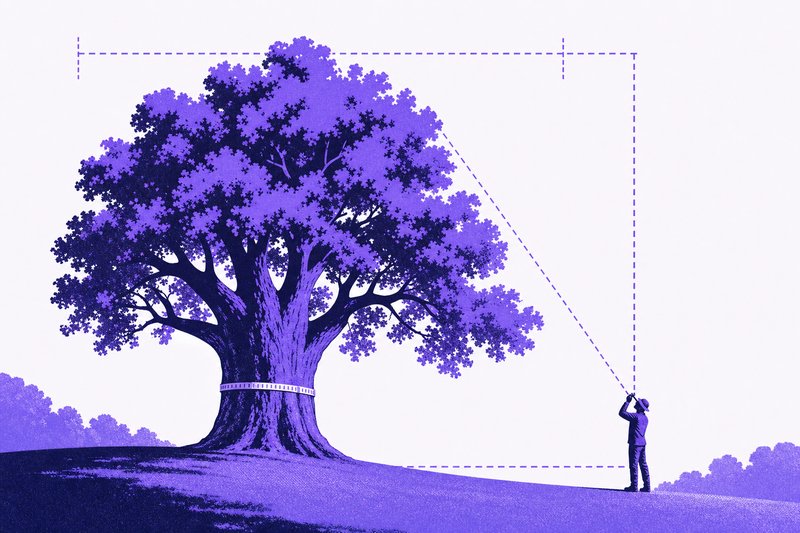
Trunk circumference in inches, plus height in feet, plus one quarter of the average crown spread in feet. Champion tree measurements come down to those three numbers. That sum, and nothing more complicated than it, is how to measure a champion tree under the scoring system American Forests uses to rank the largest known specimen of every tree species in the United States. The formula sits at the center of the American Forests Measuring Guidelines Handbook (full title: American Forests Champion Trees Measuring Guidelines Handbook), written mainly by veteran tree measurers Bob Leverett and Don Bertolette. It is the reason measurements taken decades apart, by different people with different equipment, can still be compared on the same national list.
How to Measure a Champion Tree: The Points Formula
Anyone learning how to measure a champion tree meets the formula first, and the handbook states it without much ceremony: Trunk Circumference, in inches, plus Height, in feet, plus one quarter of Average Crown Spread, in feet, equals Total Points. Three separate field measurements, added together after one of them has been divided by four. It is a deliberately simple scoring system built on top of measurement rules that are anything but simple, and the handbook is organized around exactly that split: a short formula, followed by dozens of pages on how to get each of its three inputs right.
The guide is written in tiers, aimed at three different skill levels. Beginning measurers are labeled green. Intermediate measurers and State Program Coordinators are blue. Advanced measurers, the handbook’s National Cadre of experts, are red, and they carry a longer equipment list to match: beyond the basic 100-foot tape, diameter tape, laser rangefinder, inclinometer, compass, camera, GPS unit, calculator with trigonometric functions, plumb bob and yardstick, the red-level list adds a densiometer, a monocular with a reticle, forestry calipers, an advanced hypsometer, smartphone measuring apps and a red-beam construction laser.
Circumference: Where the Tape Goes
Circumference is measured at 4.5 feet above the ground, the forestry standard known as diameter at breast height, or DBH. That single number sounds simple until the trunk stops cooperating. If it leans, the tape has to wrap at ninety degrees to the axis of the lean, not parallel to the ground, or the reading comes out too large. If there is a burl or a knot sitting right at 4.5 feet, the rule is to measure the smallest circumference found between that height and the ground instead.
Sloping ground gets its own procedure, called the mid-slope rule: locate the point roughly where the tree’s seed would have first landed, mark 4.5 feet up from the uphill side of the trunk and 4.5 feet up from the downhill side, then take the girth midway between those two marks, keeping the tape perpendicular to the trunk the entire time. Multi-trunk trees carry their own decision tree. Fused trunks are measured at the largest one. A tree that splits below 4.5 feet is measured at its narrowest point between the split and the ground. A tree that splits above 4.5 feet is simply measured at 4.5 feet. Where it genuinely is not clear whether a multi-trunk form is one tree or several, the handbook has a dedicated procedure for that too, called the Pith Test, described in full in the handbook’s first appendix alongside the program’s formal definition of what counts as a single tree.
Six labeled diagrams walk through the different trunk shapes a measurer is likely to encounter in the field: a single upright trunk, a leaning trunk, trunks that fuse partway up, and low forks that split before reaching breast height. Each diagram pairs with its own short rule, so a measurer standing in front of an unusual tree can match its shape to the closest diagram rather than guess at how the general rule should apply. That level of specificity is a large part of why champion tree measurements taken by different people, in different states, decades apart, can still be trusted against each other.
Height: Three Stick Methods and “The Preferred Method”
The handbook covers several ways to get a tree’s height, starting with three older “stick methods” and the traditional tangent method, including a version done through a smartphone app. It is candid about where those older methods go wrong, with a section literally titled “Pitfalls of the Stick Method.” Its own recommendation is what it calls, without qualification, “The Preferred Method”: the sine method, which calculates height trigonometrically using a hypsometer or inclinometer, rather than estimating it from a single angle sighting the way the stick and tangent methods do. Variants of the sine method bring in more advanced tools again: sine-tangent combinations, section-based measurements, and red-beam construction lasers for the National Cadre tier.
Crown Spread and a Worked Example
Crown spread is the last step in how to measure a champion tree, and it is measured with an Axis Method or a Spoke Method: find the canopy’s widest diameter, find the diameter perpendicular to it, and average the two. For trees that cannot be walked under safely, or whose canopy is hard to reach on foot, the handbook adds an Azimuth-Difference method and an External Baseline method, both designed to let a measurer work out crown spread from a fixed point some distance away, plus the option of a densiometer for a rougher canopy-cover reading where precision matters less.
Equipment scales with skill level throughout the handbook, and the baseline list is worth stating in full, since it is the minimum any measurer is expected to carry regardless of tier: a 100-foot tape, with 200 feet preferred, a diameter tape, a laser rangefinder, an inclinometer, a compass, a digital camera, a GPS receiver, a scientific calculator with trigonometric functions, a plumb bob, and a yardstick or meterstick. Advanced National Cadre measurers add a densiometer, a monocular with a reticle, forestry calipers, an advanced hypsometer, smartphone measuring apps, and a red-beam construction laser on top of that baseline kit.
Put a hypothetical tree through the whole formula and the arithmetic becomes concrete rather than abstract. Take a large white oak — not a real recorded specimen, simply an illustration — with a trunk circumference of 200 inches, a height of 100 feet, and an average crown spread of 60 feet. The crown-spread term is divided by four first: 60 divided by 4 is 15. Add that to the circumference and the height, 200 plus 100 plus 15, and the tree scores 315 points. Real champion tree measurements follow that exact same arithmetic; only the three input numbers change from tree to tree.
Behind the American Forests Measuring Guidelines Handbook
The program this handbook serves is older than the guide itself by many decades. It traces to a September 1940 issue of American Forests magazine, in an article called “Let’s Find and Save the Biggest Trees” by forester Joseph Sterns. The first tree ever nominated under the resulting program was a chestnut oak in Suffield, Connecticut, that same year. American Forests, already 65 years old in 1940, had a hand in creating both the U.S. Forest Service and the field of arboriculture in the country; since then it has planted nearly 50 million trees in threatened ecosystems, and the National Big Tree Program has been sponsored by the Davey Tree Expert Company since 1990.
The working group behind the handbook was not a single-author effort. Beyond Leverett and Bertolette, the credited contributors include Donna Baldwin, Don Bragg and Phil Radke, with Pete Smith and coordination first by Sheri Shannon between 2012 and 2014 and then by Bryant Smith through 2015 — a multi-year, multi-person process that shows in the handbook’s level of detail, and in its two appendices: Appendix I covering the formal tree definition and the Pith Test for multi-trunk forms, Appendix II a full glossary of the measurement terms used throughout.
The American Forests Measuring Guidelines Handbook itself is not presented as a finished, permanent standard. It describes its own contents as “works in progress” that will “undergo revision,” which is a fairly unusual thing for a technical reference to say about itself out loud. In January 2024, American Forests announced that stewardship of the National Champion Tree Program would move to a new institutional home at the University of Tennessee Institute of Agriculture. Readers looking for the current register, or for any measuring guidance issued since that move, should treat this handbook as the methodology’s foundation rather than its final word, and check both American Forests’ own champion-tree pages and the program’s new home for what has changed since.